


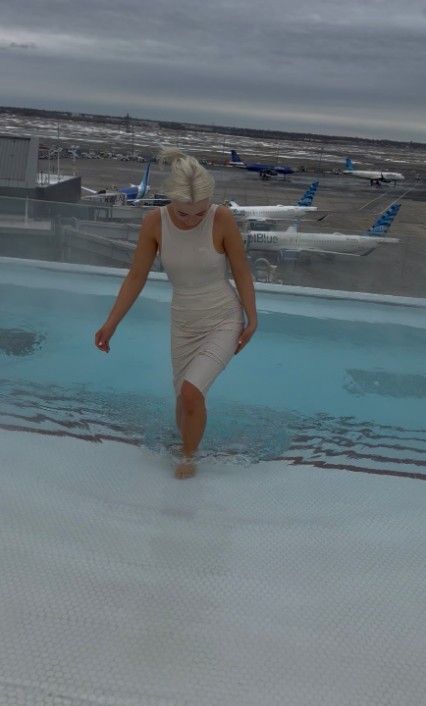
Hayley Cannon (Segar) did not change out of her wedding dress the next day either. She wore it straight into the TWA Hotel rooftop pool.
📖 YOU MIGHT ALSO LIKE
- BEYOND DESSERT: PAIRING FINE WINE WITH ARTISAN CHOCOLATE
- Chick-fil-A Is Bringing Back Cow Appreciation Day and Three Fan-Favorite Items This Summer
- Louis Vuitton Launches City Guide Resorts in a New Compact Format Covering Bodrum, Marbella, Portofino, and Taormina
- Jaeger-LeCoultre's Reverso Stories Pop-Up Brings 94 Years of Watchmaking to Miami Design District
The founder of onewith, a swimwear label known for its patented elastic-free bonded construction, eloped in New York City wearing a custom bridal gown she designed and built from her own brand's core material. The dress read ivory and minimalist from across the room. Up close, it was the same second-skin fabric that turned onewith into a cult swimwear label, adapted into a midi-length silhouette for the occasion. No boning, no structure, nothing ceremonial about the construction except the intention behind it.
onewith built its following on the premise that swimwear does not need elastic to hold its shape or its wearer. The brand's approach to bonded, elastic-free construction placed it in a niche that sits somewhere between performance and luxury, drawing coverage from fashion publications and a customer base that tends to be vocal about what the fabric feels like on the body. The Idlewild one-piece, one of the brand's signature styles, became a reference point for that construction, known for its clean lines and the way it moves with the body rather than against it.
Hayley Cannon's Wedding Dress Was Built From the Idlewild One-Piece's DNA
Cannon adapted the Idlewild's neckline into a bridal shape, transforming a garment designed for water into something made for vows. The dress was designed in secret, as a surprise for her fiancé. She did not want something she would change out of, she said. She wanted something she could live in. So she built it.
The result was a gown that functioned like a wedding dress visually and like a swimsuit structurally. The fabric, the same patented bonded material the brand sells at retail, brought no ceremony-only stiffness with it. That was the point. The following day, Cannon took the dress to the TWA Hotel rooftop pool and got in the water wearing it. No preservation, no archive. The dress was made to swim in, and it did.

The Elopement and What It Says About the onewith Brand
The decision to wear a proprietary material to a personal milestone was not lost on the brand's positioning. For a label that has built its identity around the idea that construction should serve the body rather than constrain it, a founder willing to marry in it and swim in it after is about as strong a proof of concept as a brand can offer.
The cultural context is real too. Bridal fashion has been moving away from the tradition of the unwearable dress, the one-night garment treated as a relic. More brides, particularly in the 25-to-35 demographic that onewith targets, have been pushing back against the idea that a wedding dress has to be something separate from how they actually dress and live. Cannon's elopement sits directly in that conversation, though it arrived by way of a private ceremony rather than a brand campaign.
The dress has not been put into production. It was made once, for one night, by the person who built the brand it came from. Whether onewith moves into occasion or bridal territory as a result is an open question. What the elopement demonstrated, at minimum, is that the fabric is capable of it.
Written by
FAME EditorialFAME Editorial Staff is a collective of marketers, journalists, and media professionals covering the intersection of business, culture, and entertainment. With a focus on storytelling that informs and engages, the team produces interviews, features, and industry insights that highlight the people and ideas shaping today’s landscape. Through a blend of editorial perspective and real-world marketing experience, FAME delivers content designed to resonate with modern audiences and decision-makers alike.